Overall Tech Experience Index in China Continues to Climb, While Execution Index Declines for First Time in Four Years, J.D. Power Finds
Mercedes-Benz, AITO, TANK and ZEEKR Rank Highest in Respective Segments
SHANGHAI: 28 May 2026 – The Tech Experience Index in China continues its strong momentum, increasing by 70 overall satisfaction points (on a 1,000-point scale) reaching a record high of 658, according to the J.D. Power 2026 China Tech Experience Study (TXI). The Market Depth Index score surged to 428 points. However, the Execution Index, for the first time in 4 years, declined to 875 points, showing a clear divergence between Market Depth and Execution. New Energy Vehicles (NEVs) further extended their leading position in Market Depth Index surpassing internal combustion engine (ICE) vehicles; and the gap between different segments in Market Depth is widening further.
The study, now in its sixth year, measures the TXI Innovation Index—which consists of the Technology Execution Index[1] and Market Depth Index,[2] both of which are equally weighted—to determine how effectively each automotive brand brings technologies to market. The indices combine the level of adoption of new technologies for each brand with excellence in execution. In addition, the Execution Index examines how much owners like the technologies and how many problems they experience while using them.
“Owner satisfaction on technology execution has reached its inflection point,” said Sean Wang, general manager of vehicle product competitiveness solutions at J.D. Power China. “This indicates that the involution feature-loading and proliferating has their limits. Instead of ‘more features,’ the focus of future competition would be about ‘better experience.’”
From a quality perspective, a few key trends emerged from the data. Vehicle owners indicated more problems with the driving experience than with actual vehicle malfunctions. Issues related to technology instability and inaccuracy make up 48% of all complaints, making them the biggest concern. Additionally, domestic start-ups manage quality well while still offering competitive features, however, domestic affiliated brands are widely adopted but also receive more complaints. Conversely, international brands provide a more stable and reliable experience, but are slower to introduce new features.
Following are some key findings of the 2026 study:
- Awareness of intelligent features continues to rise: Vehicle owner awareness of perceived intelligent features reaches 10.7 in 2026. The rise is particularly noticeable among NEVs, while ICE‘s growth lags. Such awareness with ICE vehicles is consistently lower than NEVs even within the same price point. Owners with vehicles less than 100,000RMB have a relatively low awareness of intelligent features.
- Instability becomes more pronounced, responsiveness and effectiveness are pivotal: Despite the overall surge of the tech experience index, the complexity of the execution index also becomes noticeable. 2026 overall quality complaints are increased by 22 PP100, in which the total number of complaints for smart cockpits is high, but smart driving has seen a significant increase. Generally, instability/inaccuracy issues in smart driving registered a notably larger increase of 48%, usability-related complaints declines. Domestic startup brands’ quality performance remained robust, domestic affiliated brands and international brands need to pay closer attention to the quality of their advanced features.
- Post-00s merge as bellwether of intelligent experience: Post-00 consumers demonstrate the strongest awareness and highest sensitivity of tech experience, leading all generations in the recognition of market depth—a trend that is even more pronounced in the new energy vehicle (NEV) segment. Their biggest complaints center on instability and inaccuracy and they are among the least tolerant of poor user experiences. At the same time, features that are considered low value or unlikely to drive repurchase among the overall population, such as automated parking and traffic jam assist, are much more appealing to post-00s buyers. They have a stronger affinity for advanced and innovative features, bigger needs in scenario-based entertainment, higher willingness of repurchase in terms of innovative/health related features, yet the pass-through of the feature values is the bottleneck.
-
Demands in scenario-based intelligent driving and cockpit experiences have surged: Penetration of features such as intelligent exterior lighting, safe exit, navigation-on-pilot driving and intelligent in-cabin ambient lighting has increased by 35%, 32%, 31% and 28% respectively. Study data on retained users shows that most features remain unexplored are navigate-on-pilot driving, in-cabin multi-scene modes, exterior intelligent lighting, and smart seat interaction making them the optimal choices for OEMs to differentiate their products from peers.
Highest-Ranked Brands
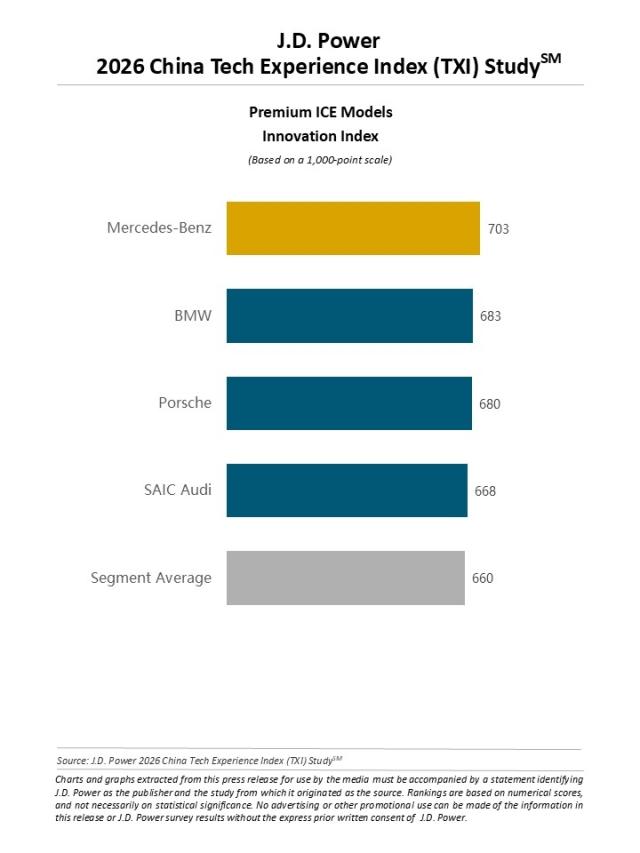
Mercedes-Benz ranks highest among premium internal combustion engine (ICE) models with a score of 703, followed by BMW (683) and Porsche (680).
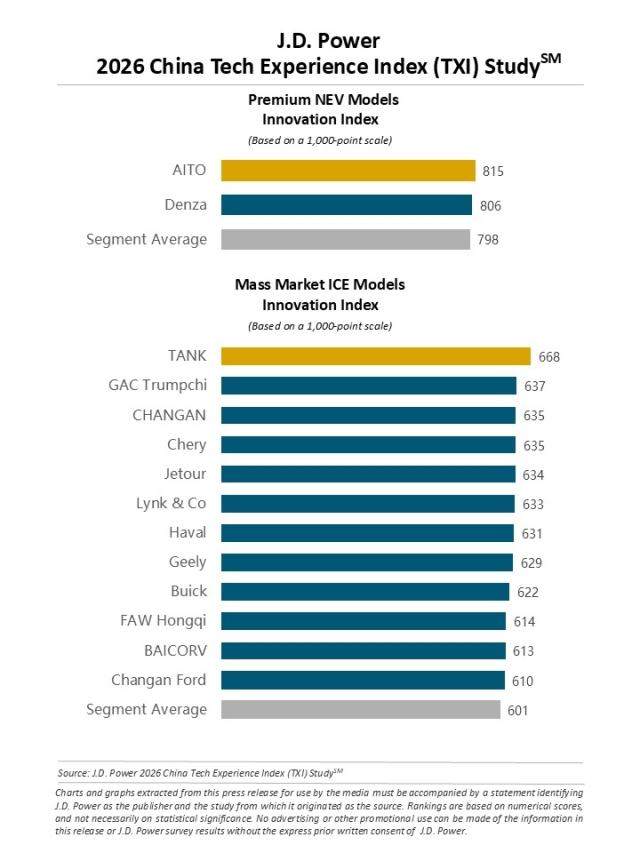
AITO (714) ranks highest among premium new-energy vehicles (NEVs), followed by Denza (711).
TANK ranks highest among mass market ICE models with a score of 668, followed by GAC Trumpchi (637), CHANGAN and Chery rank third in a tie with a score of 589.
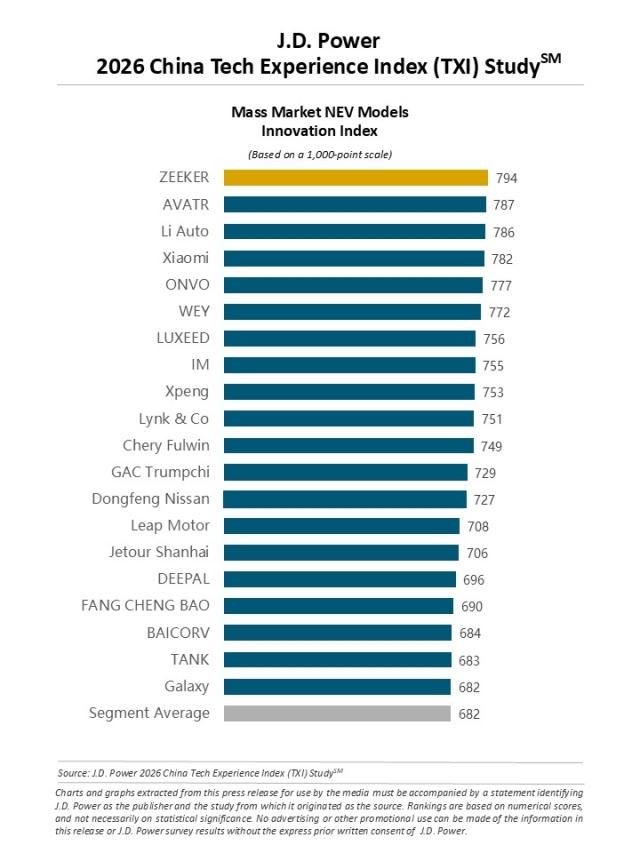
ZEEKR ranks highest among mass market NEVs with a score of 794, followed by AVATR (787) and Li Auto (786).
The China Tech Experience Index (TXI) Study, now in its seventh year, which complements J.D. Power China Initial Quality Study (IQS) and China Automotive Performance, Execution and Layout (APEAL) Study. The study is used extensively by automakers and suppliers worldwide to provide an overview of how vehicle owners in China perceive the advanced technologies in their new vehicle and to help the industry address any problematic areas before the technology features are made widely available across automotive portfolios, thus improving the future owner experience.
The 2026 study, which includes 127 ICE models from 34 brands and 128 NEV models from 48 brands, is based on the feedback of 13,467 ICE vehicle owners who purchased their vehicles between July 2025 and February 2026, as well as 19,346 NEV owners who purchased their vehicle between May and December 2025. The study for ICE vehicle owners was fielded from January through April 2026 and the study for NEV vehicle owners was fielded from November 2025 through February 2026 in 81 major cities across China.
J.D. Power is a global leader in consumer insights, advisory services and data and analytics. Those capabilities enable J.D. Power to help its clients drive customer satisfaction, growth and profitability. Established in 1968, J.D. Power has offices serving North America, Asia Pacific and Europe. For more information, please visit china.jdpower.com or stay connected with us on J.D. Power WeChat and Weibo.
Media Relations Contacts
Scarlette Wang, J.D. Power; China; +86 21 8026 5719; sijia.wang@jdpa.com
Joe LaMuraglia, JD Power; U.S.; 714-621-6224; media.relations@jdpa.com
About J.D. Power and Advertising/Promotional Rules www.jdpower.com/business/about-us/press-release-info
[1] The Technology Execution Index is formulated from respondents’ overall experience and the total problems experienced with the advanced technologies they have and use. The index weights are derived from survey responses using multivariate linear regression. As a result, the index weights could differ by study market or study year.
[2] The Market Depth Index is a measurement of the penetration level of advanced technologies. The calculation encompasses the level of equipment penetration and usage of advanced technologies.