Amid Intensifying Competition, NEV Brands Shift from Price Wars to Product Excellence to Win on Customer Value, J.D. Power Finds
SHANGHAI: 26 Mar. 2026 – Amid intensifying market competition, New Energy Vehicle (NEV) manufacturers are rapidly shifting the focus of competition from price and configuration to overall product experience and customer value, aiming to win over consumers through product excellence. For NEVs, product excellence is measured as customer satisfaction with the appeal of their new vehicle in the J.D. Power 2026 China New Energy Vehicle–Automotive Performance, Execution and Layout (NEV-APEAL) Study,SM released today. The industry average satisfaction score for NEVs in China has reached 829 (on a 1,000-point scale), marking a significant increase of 23 points from 2025.
The study examines NEV owners’ appeal—or emotional attachment and level of excitement—with their new vehicle within the first two to six months of ownership. The data is used extensively by NEV manufacturers to design and develop more appealing vehicles.
The study this year shows that by powertrain type, plug-in hybrid electric vehicles (PHEVs) have the largest improvement in NEV-APEAL scores, increasing by 29 points year over year, while battery electric vehicles (BEVs) and range-extended electric vehicles (REEVs) each improve by 21 points. Additionally, BEVs regain market share on stable pricing and stronger product performance.
“Compared with 2025, the NEV-APEAL score in 2026 surged by 23 points, a growth rate exceeding that of the past three years,” said Sean Wang, managing director of automotive product solutions division, J.D. Power China. “This indicates users have recognized the design innovation of China’s new energy vehicles. At the factor level, safety saw the biggest gain, up 29 points from 2025. By contrast, range satisfaction improved by 17 points, the smallest increase, while its factor weight declined noticeably. Advances in China’s NEV battery, motor and electronic control technologies have largely met consumer range expectations, making range less influential in purchase decisions. Chinese independent NEV brands continue to gain share, dominating the premium segment above ¥400,000 with 83% of sales, while driving volume below ¥200,000 through strong value. The market is becoming more segmented, with post-2000 buyers now exceeding 10% of purchases and favoring entry-level EVs as their first vehicle.”
Following are some key findings of the 2026 study:
- BEVs regain strong market share: In 2026, the BEV share of the NEV market rises to 66.9%, up from 58.5% in 2025. Despite continuous improvements in product performance, the average transaction price increases by only RMB 400, remaining highly stable. Meanwhile, the market shares for PHEVs and REEVs decline by 6.6 and 1.9 percentage points, respectively, accompanied by rising average transaction prices. Among them, PHEVs see the most significant increase (+RMB 21,400), while REEVs rise by RMB 17,200.
- Emerging NEV brands achieve breakthroughs: Domestic brands continue to lead in this year’s study, with an average score of 834, while the average transaction price reaches RMB 265,600. Driven by both strong product performance and enhanced brand premium, these brands achieve simultaneous growth in sales and revenue, with revenue share reaching 40% in 2026, indicating a gradual balance between scale expansion and value creation.
- Post-00s consumers emerge as the most demanding NEV buyers: The study finds that satisfaction among the youngest vehicle owners averages 814, significantly below the industry average (829) and scores among these owners are lower across all evaluation factors than among owners in other age groups. Currently, 71% of post-00s car buyers concentrate in the under-200,000 RMB market, making them the main force in the economy segment. They have more frequent needs for traveling with pets and outdoor camping.
Highest-Ranked Models
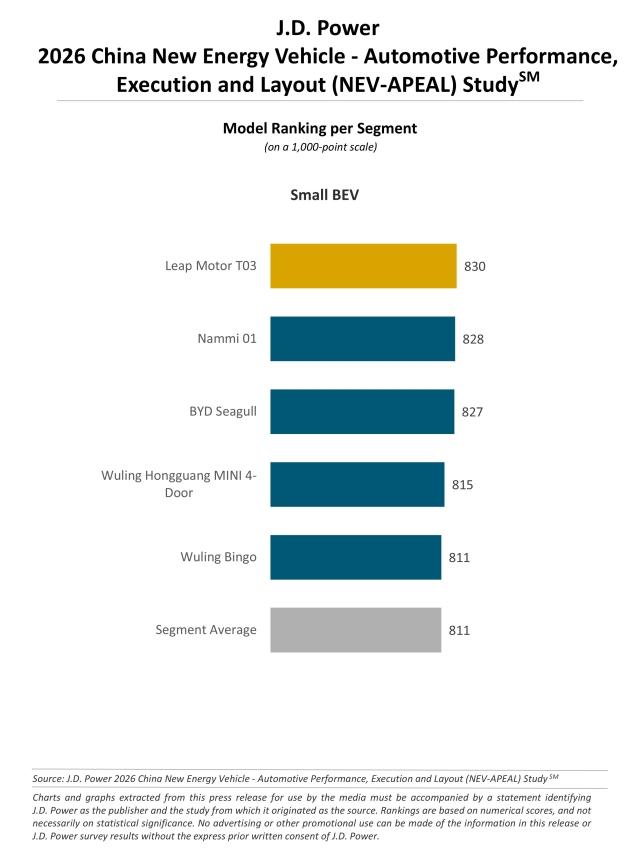
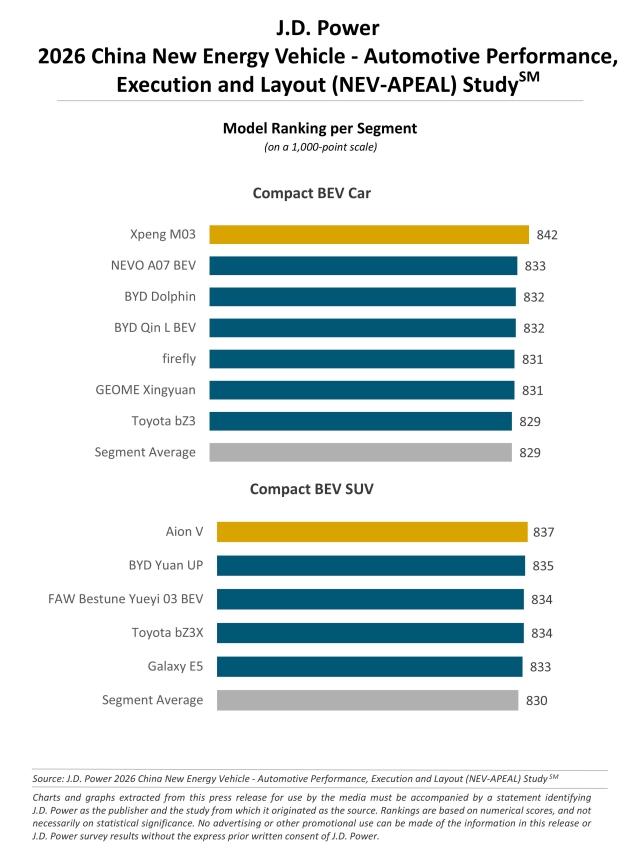
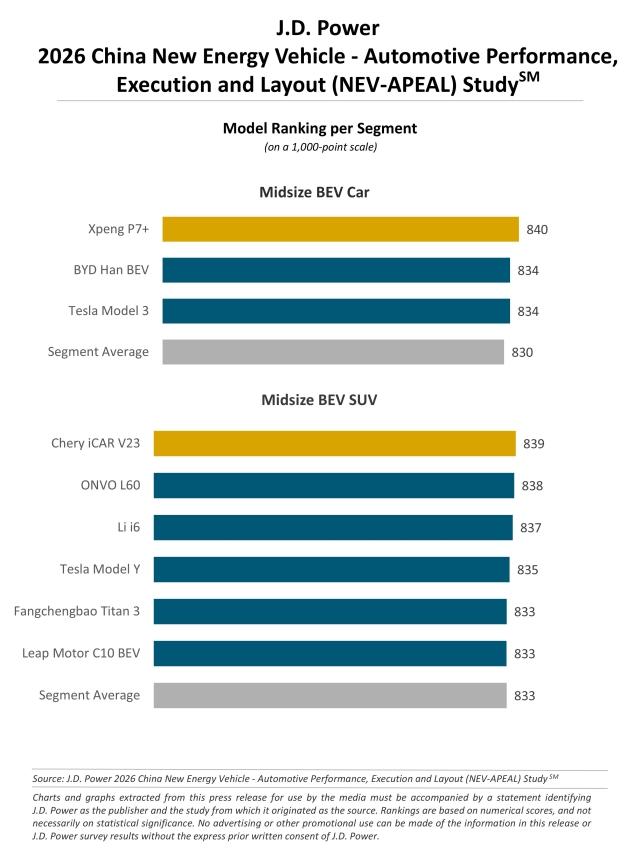
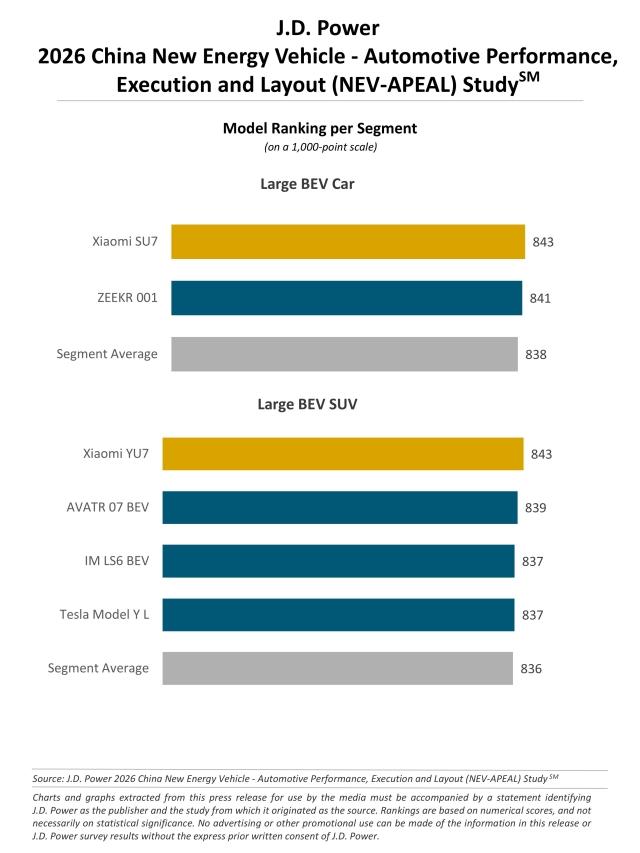
Models that rank highest in their respective segments[1] are:
- Small BEV: Leap Motor T03
- Compact BEV Car: Xpeng M03
- Compact BEV SUV: Aion V
- Midsize BEV Car: Xpeng P7+
- Midsize BEV SUV: Chery iCAR V23
- Large BEV Car: Xiaomi SU7
- Large BEV SUV: Xiaomi YU7
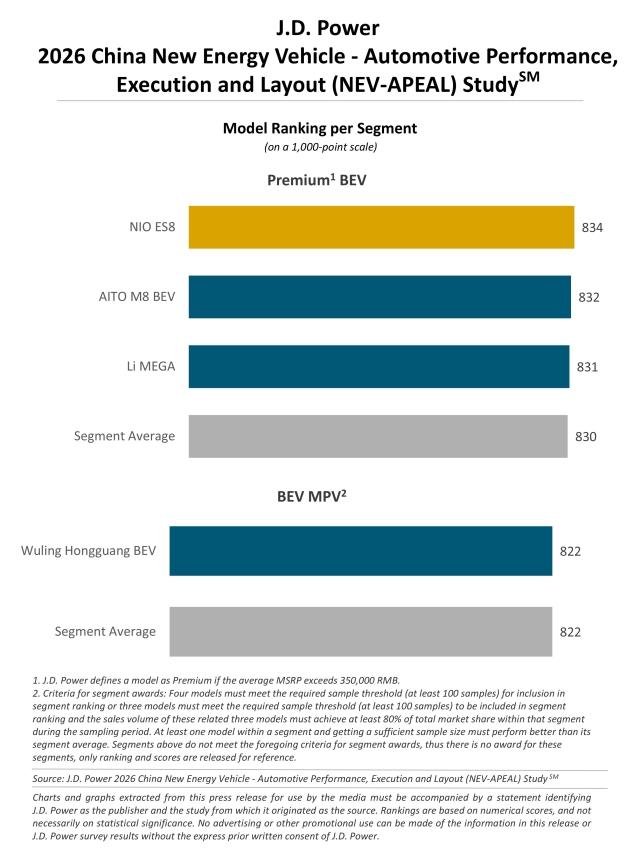
- Premium BEV: NIO ES8
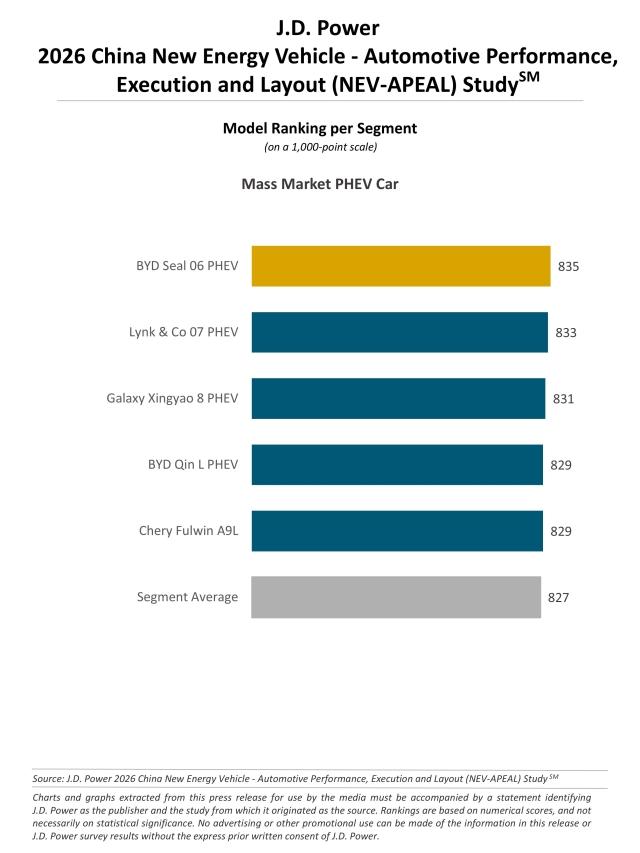
- Mass Market PHEV Car: BYD Seal 06 PHEV
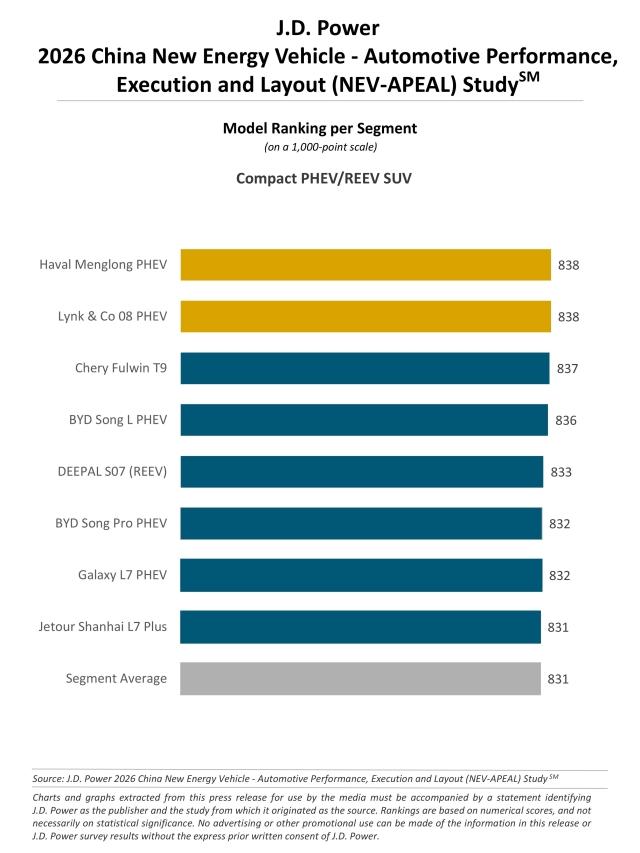
- Compact PHEV/REEV SUV: Haval Menglong PHEV; Lynk & Co 08 PHEV[2]
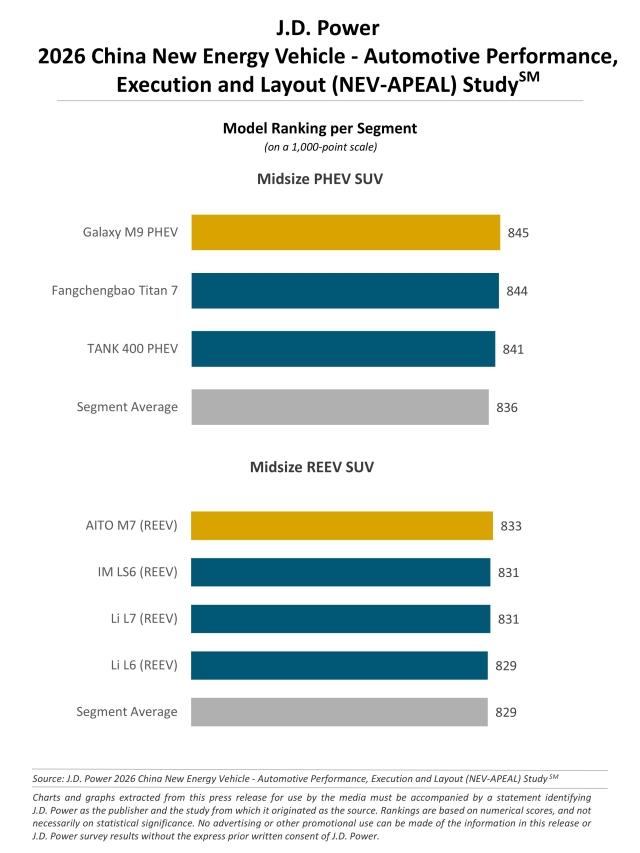
- Midsize PHEV SUV: Galaxy M9 PHEV
- Midsize REEV SUV: AITO M7 (REEV)
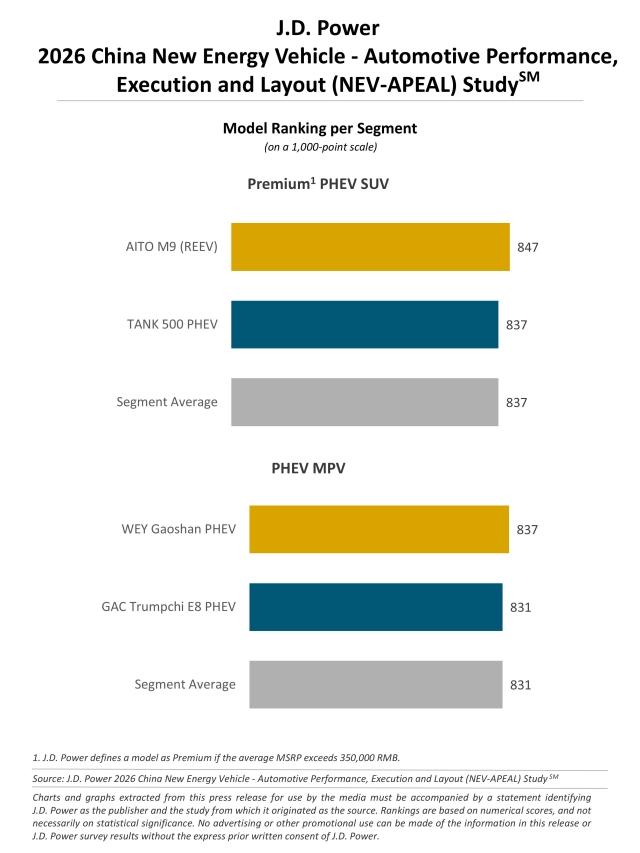
- Premium PHEV SUV: AITO M9 (REEV)
- PHEV MPV: WEY Gaoshan PHEV
The BEV MPV segment criteria for awards were not met, therefore no awards are given this year.[3]
The China New Energy Vehicle–Automotive Performance, Execution and Layout (NEV-APEAL) Study measures NEV owners’ emotional attachment to and level of excitement with their new vehicle across 45 attributes in 11 vehicle experience categories: exterior; setting up and starting; getting in and out; interior; performance; driving feel; keeping you safe; infotainment; driving comfort; fuel economy and driving range; and charging experience.
The 2026 study is based on responses from 21,512 new energy vehicle owners who purchased their vehicle between May and December 2025. The study includes 137 models from 49 different brands, among which 129 models have sufficient samples. The study was fielded from November 2025 through February 2026 in 81 cities across China.
To learn more about the China New Energy Vehicle–Automotive Performance, Execution and Layout (NEV-APEAL) Study, please contact us: china.marketing@jdpa.com
About J.D. Power
J.D. Power is a global leader in consumer insights, advisory services and data and analytics. Those capabilities enable J.D. Power to help its clients drive customer satisfaction, growth and profitability. Established in 1968, J.D. Power has offices serving North America, Asia Pacific and Europe. For more information, please visit china.jdpower.com or stay connected with us on J.D. Power WeChat and Weibo.
Media Relations Contacts
Wenjing Ji, J.D. Power; China; +86 21 8026 5719; wenjing.ji@jdpa.com
Joe LaMuraglia, J.D. Power; USA; 001-714-621-6224; media.relations@jdpa.com
About J.D. Power and Advertising/Promotional Rules www.jdpower.com/business/about-us/press-release-info
[1] In 2026 J.D. Power New Energy Vehicle Automotive Performance, Execution and Layout (NEV-APEAL) StudySM the number of vehicle models covered in the Large BEV segment increased from 8 in 2025 to 15, enabling further segmentation of this market by body type. Meanwhile, since the Small BEV segment covers only one SUV model, it is no longer segmented by body type. The Compact PHEV SUV segment includes only two REEV models, so it is no longer segmented by powertrain type. The PHEV MPV segment covers only two premium models, thus it is no longer segmented by price. As a result, J.D. Power new energy vehicle segments classification is reduced from 18 in 2025 to 16 in 2026. Due to the aforementioned changes, this report does not present the ranking data for the following segments in 2025: Small BEV Car, Small BEV SUV, Large BEV, Compact PHEV SUV, Compact REEV SUV, Premium PHEV MPV and Mass Market PHEV MPV segments.
[2] Criteria for segment awards: Four models must meet the required sample threshold (at least 100 samples) for inclusion in segment ranking or three models must meet the required sample threshold (at least 100 samples) to be included in segment ranking and the sales volume of these related three models must achieve at least 80% of total market share within that segment during the sampling period. At least one model within a segment and getting a sufficient sample size must perform better than its segment average. Segments above do not meet the foregoing criteria for segment awards, thus there is no award for these segments, only ranking and scores are released for reference.
[3] Models with identical scores are sorted alphabetically.